
Speech
Closing Remarks at the National Performance Review Conference 2026
17 April 2026
*The theme of the conference was “Coordinated Actions for National Social-Economic Transformation amidst global partnership reforms”
Salutations
- Rt. Hon. Prime Minister, Robinah Nabbanja.
- Honourable Ministers.
- Excellencies; the Ambassadors.
- Honourable Members of Parliament.
- Deputy Executive Secretary of the Economic Commission for Africa
- District Chairpersons.
- Government Officials.
- Representatives of Development Partner Organisations.
- Representatives of Civil Society Organisations.
- Representatives of the Private Sector.
- Representatives of Academia and Research Institutions.
- Colleagues from the United Nations System.
- Ladies and Gentlemen.
Right Honourable Prime Minister,
- Allow me to begin by thanking you, most sincerely, on behalf of the Local Development Partners’ Group and the United Nations Country Team, for your steady leadership and clear direction. Your consistent emphasis on self‑reliance, production, accountability, and national ownership continues to guide all of us who are privileged to walk with Uganda on its development journey.
- As has often been said in this country, “Real development is not donated—it is built.” Your leadership has kept that principle firmly at the centre of Uganda’s transformation agenda.
- We are deeply grateful to the Government of Uganda—especially the Rt. Hon. Prime Minister—for convening this National Performance Review Conference as a true accountability platform. Bringing together national planning, sector performance, local government delivery, and development cooperation in one space is no small achievement. This integration sends a strong message: performance matters, and results must be visible to the Ugandan people.
- In that same spirit, the Joint Steering Committee between Government and the United Nations was deliberately embedded in this Conference. This was not ceremonial. It was practical. It affirmed a shared resolve to ensure that external support aligns fully with national systems, national priorities, and national results.
Right Honourable Prime Minister,
- The discussions allowed us to take stock - and the results speak clearly.
- Despite disease outbreaks, Uganda sustained 95% national immunization coverage.
- More than 68,000 children with severe acute malnutrition received life‑saving treatment.
- Over 126,000 out‑of‑school children returned to learning.
- 53,000 young people accessed jobs through coordinated skills and enterprise efforts.
- And more than 800,000 Ugandans accessed clean energy solutions—improving livelihoods while protecting the environment.
- These are not just statistics. They are proof that when leadership is clear, systems are strong, and partnerships are coordinated, results follow. As our people always say, “When the direction is right, even the journey becomes shorter.”
- At the same time, this Conference has been honest about where more effort is needed. Financing sustainability, implementation coherence, and persistent delivery bottlenecks remain areas that deserve our collective focus. As partners, we do not see these as shortcomings, but as shared work ahead.
- One message that has come through strongly: agility matters. In a world of climate shocks, tighter financing, displacement, and global uncertainty, protecting progress will depend on our ability to adapt quickly, prioritize wisely, and invest in resilient systems. “A country that learns fast, survives long.”
- Closely linked to this is the evolving financing landscape. As Uganda advances toward greater self‑reliance, we see strong opportunities to expand domestic resource mobilization, blended finance, climate finance, diaspora financing, and private investment. We reaffirm our commitment to walk with Government in unlocking these pathways—so that national priorities are financed sustainably, by design.
Right Honourable Prime Minister,
- The discussions on Karamoja, led by the Rt. Hon. Prime Minister, reminded us that solidarity must go hand in hand with long‑term strategy. The recently mobilized US$5 million emergency nutrition support is an important response. But as was clearly emphasized, lasting transformation in Karamoja will come through aligned investments in water for production, livelihoods, household assets, and stronger coordination under the Karamoja Regional Development Plan.
- As partners, we remain fully committed to supporting Government’s efforts so that the people of Karamoja can move from vulnerability to resilience and self‑reliance.
- My second takeaway from this Conference is that Uganda’s demonstration of growing leadership in practical development coordination and accountability. Few countries manage to bring central government, districts, partners, and communities into one performance conversation. This is a model worth sharing beyond Uganda.
- And it has reminded us that transformation is built from the ground up. District systems, local governments, and initiatives such as the Parish Development Model are where national priorities meet real lives.
Right Honourable Prime Minister, distinguished ladies and gentlemen
- As we conclude, let me reaffirm—on behalf of the Local Development Partners’ Group and the United Nations Country Team—our full commitment to supporting Uganda under the new UN Sustainable Development Cooperation Framework 2026–2030.
- We stand ready to translate the discussions of this Conference into action—strengthening systems, accelerating digital transformation, leveraging public‑private partnerships, enhancing local government performance, and keeping citizens at the centre of service delivery.
- With your leadership, we are confident Uganda will continue moving steadily toward the ambitions of Vision 2040, the 2030 Agenda, Africa Agenda 2063, and East Africa Vision 2050.
- Let us leave this Conference with a shared resolve: to convert strong plans into strong delivery, and strong delivery into lasting change for every Ugandan. We can do this without leaving anyone behind.”
Thank you very much!
Asanti Sana!
Weebale nyo!


Speech by
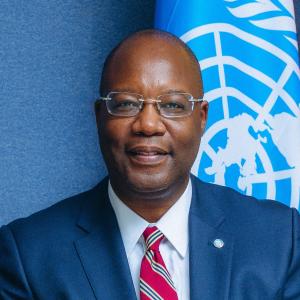
Leonard Zulu
RCO
UN Resident Coordinator
Goals we are supporting through this initiative


UN entities involved in this initiative
FAO
Food and Agriculture Organization of the United Nations
IFAD
International Fund for Agricultural Development
ILO
International Labour Organization
IOM
International Organization for Migration
ITC
International Trade Centre
RCO
United Nations Resident Coordinator Office
UN Women
United Nations Entity for Gender Equality and the Empowerment of Women
UN-Habitat
United Nations Human Settlements Programme
UNAIDS
Joint United Nations Programme on HIV/AIDS
UNCDF
United Nations Capital Development Fund
UNDP
United Nations Development Programme
UNEP
United Nations Environment Programme
UNFPA
United Nations Population Fund
UNHCR
United Nations High Commissioner for Refugees
UNICEF
United Nations Children’s Fund
UNIDO
United Nations Industrial Development Organization
UNODC
United Nations Office on Drugs and Crime
UNV
United Nations Volunteers
WFP
World Food Programme
WHO
World Health Organization