Remarks at the 7th Regional Ministerial Forum on Migration (RMFM)
Theme: "Expanding Regular Labour Migration Channels to Promote Skills Mobility, Decent Employment, and Safe Alternatives to Irregular Migration"
Salutations:
- Honourable Esther Anyakun Davinia – Chair of the RMFM and the Minister of State for Labour, Employment, and Industrial Relations, of the Republic of Uganda;
- Honourable Ministers from the RMFM Member States;
- Honourable Ministers from the GCC, Jordan and Lebanon;
- Government Representatives from the Sultanate of Oman;
- Government of Uganda Ministries present;
- The IOM Regional Director for East, Horn and South Africa;
- Members of the Diplomatic Corps including Ambassadors;
- Distinguished Delegates and Representatives of the RMFM Technical Working Groups;
- African Union Commission Representative;
- The East African Community Representative;
- IGAD Representatives;
- The Representatives of the UK Foreign, Commonwealth and Development Office (FCDO);
- IOM Uganda Chief of Mission and UN Heads of Agencies present;
- UN Staff from various Agencies from the Regional Offices;
- Distinguished Guests, Ladies and Gentlemen.
A good morning to you all
It is a great honour to address you today at the 7th Regional Ministerial Forum on Migration. This important platform continues to demonstrate our shared commitment to advancing safe, orderly, and humane labour migration across the East and Horn of Africa.
As the United Nations, through our Agencies IOM and ILO we were privileged to have been part of this forum since its establishment in January 2020. Since then, the RMFM has stood as a vital Regional Consultative Process, bringing together Member States under a common vision. That vision is one of cooperation, solidarity, and progress toward harmonized labour migration policies that serve both our people and our economies.
I would like to commend the Chair, the Government of Uganda, for successfully mobilizing the Gulf Cooperation Council (GCC) countries to participate despite the current crisis in the region. We appreciate the presence and participation of the delegates.
The theme of the 7th RMFM is very captivating Expanding Regular Labour Migration Channels to Promote Skills Mobility, Decent Employment, and Safe Alternatives to Irregular Migration and this is firmly aligned with the Sustainable Development Goals (SDGs), particularly SDG 8 on Decent Work and Economic Growth, and SDG 10 on Reducing Inequalities. It also advances key objectives of the Global Compact for Migration, including strengthening international cooperation, promoting ethical recruitment, enhancing consular collaboration, and supporting skills development, diaspora engagement, and dignified return and reintegration.
This forum also underscores the principle of ensuring that No One is Left Behind, a principle that is deeply embedded in the 2030 Agenda.
The objectives of the forum re-echo the objectives of the SDG Summit, at which Member States, with a unified voice, reaffirmed their commitment to international cooperation, ensuring that migration remains safe, orderly, and regular—while upholding the human rights and dignified treatment of all migrants, and always remaining cognizant of national circumstances.
Ladies and Gentlemen,
We are currently also preparing for the second International Migration Review Forum (IMRF) in May 2026. Indeed, a few days ago, I participated in an important briefing for all UN Resident Coordinators in Africa on the upcoming IMRF preparations, during which it was encouraging to learn that strong African representation is planned at the highest level. It is critical to position the continent to present a unified, evidence-based voice on labour and skills mobility at this global forum.
As we gather at this pivotal moment, the 7th RMFM offers a unique political opportunity to move from policy frameworks to concrete implementation.
Over the past couple of years, the UN through its Agencies of IOM, ILO and other Agencies, have collectively developed important tools, including the Regional Model Bilateral Labour Migration Agreement, the Joint Monitoring Mechanism, and modalities for Consular and Labour Attaché collaboration. These are not just documents, they are instruments of change, designed to translate our commitments into tangible results.
Ladies and Gentlemen,
Migration remains a defining feature of our region, home to over six million international migrants. Labour mobility is driven by our youthful population, growing labour markets, and increasing demand for skills both within and beyond our borders. At the same time, challenges such as climate change, food insecurity, and water scarcity continue to shape migration patterns.
Yet migration is not merely a challenge, it is an opportunity. Migration, when navigated with precision, contributes to a nation’s development through many different ways. It helps alleviate poverty and spur economic growth—most notably through remittances. In Uganda, for example, remittances constituted approximately 3% of the country’s annual GDP 2023-2024 according to Bank of Uganda, demonstrating the tangible economic value of well-regulated labour migration and a vibrant, diverse workforce.
Migration also catalyzes investment, trade, and knowledge exchange. This includes engaging the diaspora, welcoming returning migrants, and fostering educational opportunities through scholarships. It ignites innovation and diversity within our societies, enriching our economies and institutions.
Equally important, migration can enhance security and peacebuilding, particularly when accompanied by robust efforts to combat the scourge of human trafficking and ensure the protection of vulnerable populations, which has been revealed by evidence from border governance programming initiatives.
However, we must also acknowledge the gaps that remain. Progress in implementing bilateral labour agreements has been uneven. Monitoring systems and Data are often fragmented. Skills recognition frameworks require stronger coordination. And while engagement with Gulf Cooperation Council countries has expanded, it remains largely fragmented and insufficiently aligned with a coherent regional strategy. However, it is imperative to note that there has been some progress, and an example of this is the EAC Regional Labour Migration Policy, that has been adopted; and EAC Diaspora Engagement Policy, that is under development.
Ladies and Gentlemen,
The focus of this forum on skills mobility, employment creation, and strengthened collaboration with GCC and other Gulf countries—is therefore both timely and necessary. These partnerships hold immense potential. By aligning skills supply with demand, improving recruitment systems, and ensuring the protection of migrant workers, who can create pathways that are both beneficial and sustainable.
Most importantly, this forum calls for a renewed political commitment. A commitment to expand safe and regular migration pathways with the region. A commitment to protect the rights and dignity of migrant workers. And a commitment to deepen regional and international cooperation for shared prosperity.
Ladies and Gentlemen,
The success of this Forum will not be measured by the strength of our statements, but by the impact of our actions. Let us therefore seize this moment to turn our collective vision into concrete outcomes—outcomes that improve lives, strengthen economies, and advance sustainable development across our region.
Thank you.


Speech by
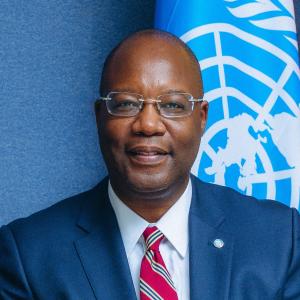
Leonard Zulu
Goals we are supporting through this initiative